Artificial intelligence is no more a distant dream but rather a reality of today’s businesses. AI in business practices leads the transformation of enterprises by implementing new ways of communication with customers, analyzing data, and engaging in various processes. Companies are integrating artificial intelligence into their operations to optimize and shorten workflows, improve customer outreach, automate repetitive tasks, and facilitate decision-making.
Recommendations, chatbots, email assistants, and other computer technologies are used in day-to-day operations and interact with people in a manner similar to humans.
The rise of artificial intelligence in business is also significant because it shifts competitive markets’ core principles. Firms that first adopt and effectively apply AI technologies in their operations gain advantages over competitors by transforming goods, services, and customer interaction models. However, the increased use of artificial intelligence in business poses some challenges, and companies should carefully consider its introduction in their operational processes.
Today, the future of artificial intelligence is not tied to robots or science-fiction films, but rather to the opportunities it creates for enterprises. Modern computers equipped with artificial intelligence can contribute to solving business problems and improving overall performance.
What Is AI in Business?
AI in business refers to the use of artificial intelligence to support, automate and enhance various commercial activities. AI systems can analyze information, identify patterns, generate content, understand language, make predictions and support employees with routine tasks.
Businesses can apply AI in various ways like:
- Analyzing customers’ behaviors,
- automating manual processes,
- generating content ideas,
- answering customers’ frequently asked questions,
- analyzing sales,
- recommending products,
- supporting marketing activities
For instance, a company’s marketing team can utilize AI technology to come up with some initial ideas for a social media marketing campaign. However, a human will be required to edit the material before it is posted.
The paragraph above highlights one of the main advantages of using AI in business. It does not necessarily mean that AI will always replace an existing process. Instead, AI can be used to improve an ongoing procedure or make it more efficient
Why Is AI Becoming Important for Businesses?
One of the key benefits of businesses using artificial intelligence is the sheer volume of data that it has to process on a daily basis.
Firms have to process information from web data, social media, customer emails, sales receipts, online reviews, advertisements, and other digital sources. All this data may take a very long time to process manually.
Artificial intelligence can process vast amounts of information allowing businesses to spot trends that would otherwise take too long to notice.
For example by looking at previous sales and customers’ browsing histories, an AI could tell an online store what items to recommend based on what a customer is browsing at the moment. This ability could allow businesses to use AI to turn mountains of data into something they can actually use.
However it is important that we don’t blindly accept everything an AI tells us, human insight and experience should always be taken into account when dealing with matters of business.
How Is AI Transforming Business?
1. AI Is Reducing Repetitive Tasks
One of the simplest applications of AI in the business is automation.
A lot of tasks that employees have to perform are repetitive, such as organizing data, summarizing, responding to frequently asked questions, generating reports, or categorizing emails.
AI can take over some of these monotonous tasks by, for instance, responding to customers’ frequently asked questions via chatbots or summarizing lengthy reports and underlining the critical points automatically.
This way, employees will have more time for less routine types of work, including creative, communicative, analytical, or strategic ones
2. AI Is Transforming Digital Marketing
Digital marketing is another sphere of people’s life that is being changed by artificial intelligence.
Marketers are using AI to research their audience, find the best ideas for their content, analyze ongoing campaigns, personalize messages, and even help with advertising.
Instead of spending hours brainstorming the best idea for a social media post, a marketer can simply ask an AI tool to generate a few possible options and then work with a human to determine which one has the most potential.
That being said, AI technology should not replace human interaction when it comes to marketing.
A good marketing campaign always relies on the audience, brand voice, creativity, and individual preferences.
3. AI Is Improving Customer Experience
Customers are expecting quick and convenient support.
Such services may be provided by means of AI.
Artificial Intelligence may offer faster customer service in the form of chatbots, assistants, response bots and recommendations.
For instance, a customer may not be able to contact a support operator immediately after placing an order during the night. Instead, an AI chatbot may be available around the clock to answer the most frequent questions.
Moreover, an AI may learn the customers’ preferences and recommend products based on that.
However, for complicated issues, customers may want to speak with another person directly.
Therefore, the future of the customer service will most probably involve both AI and human interaction.
4. AI Is Supporting Business Decision-Making
Businesses make decisions on the basis of many various factors.
The application of AI in business can contribute to the analysis of sales, customers, traffic, marketing, stock, and operations.
For instance, an organization can apply AI to learn about the fluctuations in sales and assess the marketing campaigns’ efficiency, which will offer valuable insights and aid in prioritizing efforts.
At the same time, AI in business should not be used as a replacement for judgment; instead, it should support the decision-making process by providing relevant suggestions and considering diverse aspects of the given task.
5. AI Is Creating New Business Opportunities
AI is not only helping existing businesses. It also makes it possible to create new products, services, and business models.
Many entrepreneurs can use AI in business to research their ideas, analyze customer feedback, develop early concepts, create marketing materials, and even automate part of their operations.
Small businesses can also benefit from utilizing various AI-driven tools. Even if they do not have a large technology department at their disposal or the budget to invest in in-house software developments.
In other words, the size of an organization is no longer an obstacle to adopting emerging technologies and transforming the business for the better.
So, the critical success factor for AI-enabled transformation is not whether an organization is big or small. But whether it can identify at least one pressing issue that can be solved with AI technologies.
SEO vs GEO: What Businesses Need to Know
The growth of AI is changing the ways people search for information online. Hence, SEO vs GEO has become a relevant topic for modern organizations and marketers.
SEO (Search Engine Optimization) refers to improving the visibility of a web page in traditional search engines (Google, Yahoo, Bing, etc.) through content optimization, keywords, SEO-friendly coding, backlinks, and many other techniques.
GEO (Generative Engine Optimization)aims to optimize information so that it appears in the results of AI-based search and generative systems. It enables searchers to find the data they need and rely on the quality and relevance of the answers provided.
For businesses, this trend means that online visibility is no longer just about appearing in search results and being discovered through conventional means. Nowadays people also use various question-asking tools and research instruments that utilize AI-driven technologies to find the information they need or compare available options. Businesses should, therefore, be focused on providing informative and reliable content that would help promote their expertise in a certain area.
SEO and GEO are not necessarily mutually exclusive, but rather represent different ways in which businesses can improve their visibility. For a more detailed analysis of the differences between SEO and GEO, as well as an insight into which one is more relevant for 2026, feel free to check out SEO vs GEO: Differences and Which Matters in 2026.
Benefits of AI in Business
When implemented thoughtfully, AI in business can provide several potential benefits.
Increased Productivity
AI can help employees complete certain repetitive tasks faster and spend more time on higher-value activities.
Better Use of Data
AI can analyze large amounts of information and identify patterns that can support business planning.
Improved Customer Experience
Businesses can use AI to provide faster responses and more personalized interactions.
Time Savings
Automating routine processes can reduce the amount of manual work employees need to perform.
Faster Content Creation
AI can assist with brainstorming, drafting, summarizing, and editing content.
New Business Opportunities
AI can help entrepreneurs develop new products, services, and ways of serving customers.
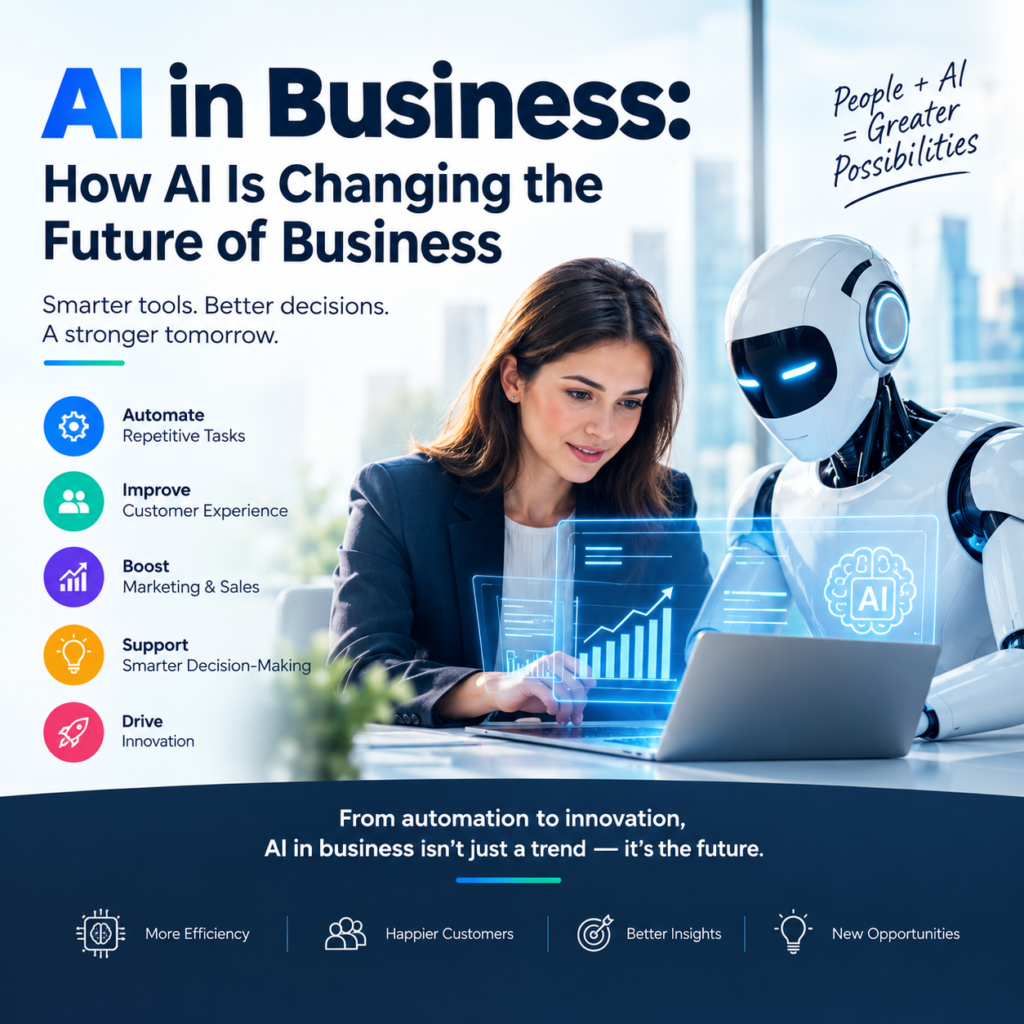
Final Thoughts
AI in business is set to change everything: the way companies function, communicate with customers, analyze information, and generate new ideas.
From automating tedious processes and enhancing customer experience to empowering marketing, decision-making, and innovation, artificial intelligence is set to become an integral part of the modern business ecosystem.
At the same time, successful AI deployment is not about adopting all the latest trends. Companies need to recognize their needs and problems and find relevant AI applications that address them.
The future of business will not be driven by AI but by human-AI collaboration. For companies that want to lead the innovation pack, the critical question is not how to use AI but where it can add value: to its business and customers.