Search is changing.
For years, businesses focused on a single target: driving visibility in Google.
Marketers researched keywords, created blog content, built backlinks and optimized websites to rank higher and appear earlier in the search engine results pages.
However, people are increasingly asking questions and expecting an answer from AI-powered search experiences.
Businesses now have a question: SEO, GEO, or both? The answer is both, as SEO vs GEO: Key Differences in 2026 are not two completely different strategies but rather complementary ones in a search environment that is increasingly AI-powered.
Google has also published guidance for how websites can optimize for generative AI features while also pointing out that existing SEO practices still play a vital role.
What Is SEO?
SEO, or Search Engine Optimization, is the practice of improving a website and its content to appear more prominently in traditional search results.
Example: if someone searches for “best digital marketing agency in Kerala,” a business would want their website to appear in the results.
This could involve:
- Keyword research
- Content creation
- On-page SEO
- Technical SEO
- Internal linking
- Building backlinks
- Improving website speed
- Optimizing titles and descriptions
- Building topical authority
The overarching goal of SEO is simple: help search engines understand your content and help users find it.
SEO is still incredibly important in 2026, and Google is actively updating its search documentation around how AI-powered search will work while still recognizing the value of traditional SEO.
What Is Generative Engine Optimization?
Generative Engine Optimization (GEO) is an emerging practice focused on making content easy to understand, use and cite by AI-powered search and answer systems.
While traditional SEO asks the question:
“How can I rank #1 on Google?”
Marketers are increasingly asking:
“How can my brand be referenced by AI systems when answering relevant questions?”
This is an important difference.
While traditional search results tend to show lists of websites, generative search can provide synthesized answers based on information from many websites.
Google’s current documentation specifically addresses optimization for generative AI features in Search and notes the importance of high-quality, non-commodity content and SEO.
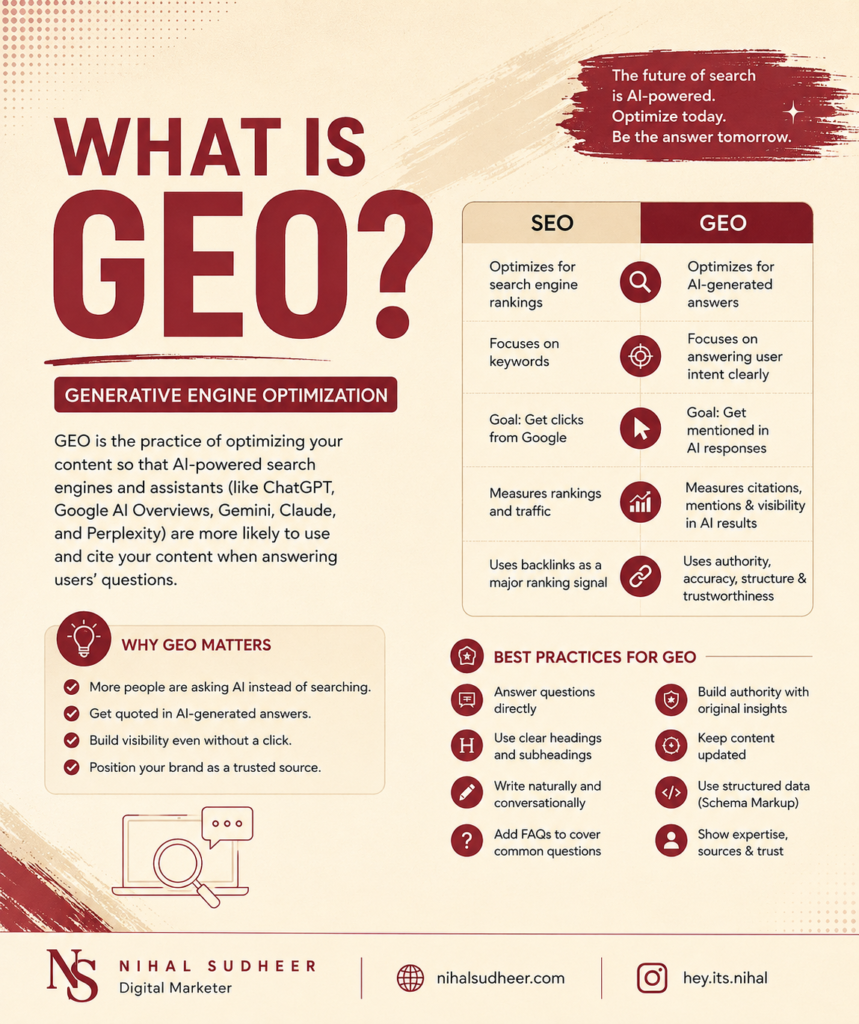
SEO vs GEO Key Differences in 2026
The easiest way to understand SEO vs GEO is to think about what each one hopes to accomplish.
SEO focuses on visibility in search results, while GEO focuses on visibility in AI-generated answers.
For example, SEO might help your article rank when someone searches for:
“What is digital marketing?”
However, GEO would aim to ensure that your content is useful and discoverable when someone asks an AI system to explain digital marketing and recommend resources to learn it.
The two strategies have significant overlap, and both rely on:
- Accurate information
- High-quality content
- Clear structure
- Expertise
- Relevance
- User-friendly experiences
- Trustworthy sources
So, rather than thinking SEO vs GEO key differences , marketers should start thinking SEO + GEO.
Why Is GEO Becoming Important in 2026?
AI-powered search is disrupting information discovery and creating new opportunities for visibility.
SEO vs GEO Key Differences in 2026 is becoming increasingly important as search continues to evolve.Google now has AI Overviews and AI Mode, and Google Search documentation has created specific guidance for how websites can optimize for generative AI features in Search. AI Mode data is also being surfaced in Search Console reporting.
At the same time, brands are becoming more aware of how they appear in AI-generated answers, and recent industry reporting has shown an increasing level of interest in Generative Engine Optimization (GEO) and AI visibility measurement.
This does not mean traditional search is disappearing. Rather, the search journey is becoming more complex, with users potentially:
- Performing a search in Google
- Reading an AI Overview
- Visiting websites
- Asking ChatGPT or similar AI tools for recommendations
- Comparing brands
- Making a purchase
Your brand needs to be discoverable across all these points in the customer journey.
How Can You Optimize Content for GEO?
There are no silver-bullet tricks to make an AI system reference your website. However, there are a number of practical principles that marketers can follow.
1. Create Original and Useful Content
Avoid creating articles just for keywords. Answer real questions and provide genuine value to your readers.
Google’s guidance highlights the importance of high-quality, non-commodity content for generative search experiences.
2. Make Information Easy to Understand
Clear headings, paragraph breaks, lists, definitions and sections can all help make information easier to understand for humans and search systems.
Avoid hiding important information behind complex explanations.
3. Demonstrate Experience and Expertise
AI systems need reliable information.
Showcase who you are, provide expertise where appropriate, use credible sources and keep important information up to date.
4. Answer Specific Questions
Rather than simply writing articles, create content that directly answers the questions your audience has.
For example, “What is SEO?” is helpful, but “SEO vs GEO: Which strategy should a small business use in 2026?” has much greater decision-making value.
5. Don’t Forget Traditional SEO
This is one of the most important points.
While GEO is increasingly important, it does not mean you should completely abandon SEO.
Google’s guidance makes it clear that SEO best practices are still relevant to visibility in its generative AI search features.
Your website still needs strong technical SEO, useful content, internal linking, crawl-friendly pages and clear information architecture.
SEO vs GEO: Which Should Your Business Use?
The answer depends on your goals, but for most businesses, the best strategy is to use both SEO and GEO.
SEO can help you build long-term organic visibility, while GEO prepares you for a search environment where AI systems increasingly summarize information and recommend sources.
Think of it this way:
SEO gets your content discovered.
GEO helps prepare your content to be understood by AI-driven search experiences.
Neither should replace the other. Instead, they should work together.
The Future of Digital Marketing: Human + AI
The future of digital marketing will not be completely ruled by AI, nor will it remain completely human. It will be a combination of both, with AI helping marketers with research, data analysis, content ideas, personalization, advertising and automation, while humans will retain responsibility for strategy, creativity, emotional intelligence, brand positioning and relationships.
The most successful marketers will not necessarily be those who use the most AI, but rather those who understand when to use AI and when to use human insight.
Similarly, the most successful businesses will not simply create thousands of AI-generated pages to try and improve search rankings. Google’s spam policies explicitly warn against scaled attempts to manipulate search rankings that do not provide actual value to users.
The future of digital marketing therefore is not human vs AI, but rather human + AI. The brands that combine technology with originality, expertise and trust will have the best chance of standing out.
The Future of Search: SEO + GEO
Search will not become one singular entity.
People will continue to use traditional search engines, but also AI assistants, social platforms, video platforms and other types of discovery tools.
This means marketers need to think beyond rankings and instead ask:
“Can my brand be discovered wherever my audience is searching for information?”
SEO remains crucial for visibility in traditional search, while GEO is an increasingly important practice as AI-generated search experiences grow.
Together, they offer a powerful strategy for modern search visibility.
Final Thoughts
The discussion around SEO vs GEO key differences isn’t really about choosing one winner.
SEO remains an important foundation for digital visibility, while Generative Engine Optimization represents a new opportunity to think about how content can be discovered and understood in AI-powered search.
The smartest approach is not to abandon SEO for GEO.
It’s to build strong SEO foundations while creating content that is original, useful, trustworthy, clear and genuinely valuable.
Because whether a person discovers your business through Google or an AI-generated answer, one thing remains the same:
Useful content earns attention. Trust earns customers.
Pingback: AI in Business: The Ultimate Guide to Future Business Growth