Social media is no longer just a place for people to communicate. Rather, a company can leverage this platform to boost its recognition, engagement, sales, and leads.
Whether your niche is and you are a local business owner, an online seller, struggling entrepreneur, or social media influencer, social media marketing can help you reach your target audience without breaking the bank in your marketing endeavors.
However, it is important to note that having an Instagram account or Facebook page is only a part of a bigger picture. Your social media marketing strategy must comprise a set of well-thought guidelines that will aid in getting people’s attention, finding your niche audience, and posting relevant content consistently.
This article will discuss social media marketing’s concept and main areas that should be focused in 2026.
What Is Social Media Marketing?
Social media marketing is the process of using social media platforms to promote a business, product, service, or personal brand.
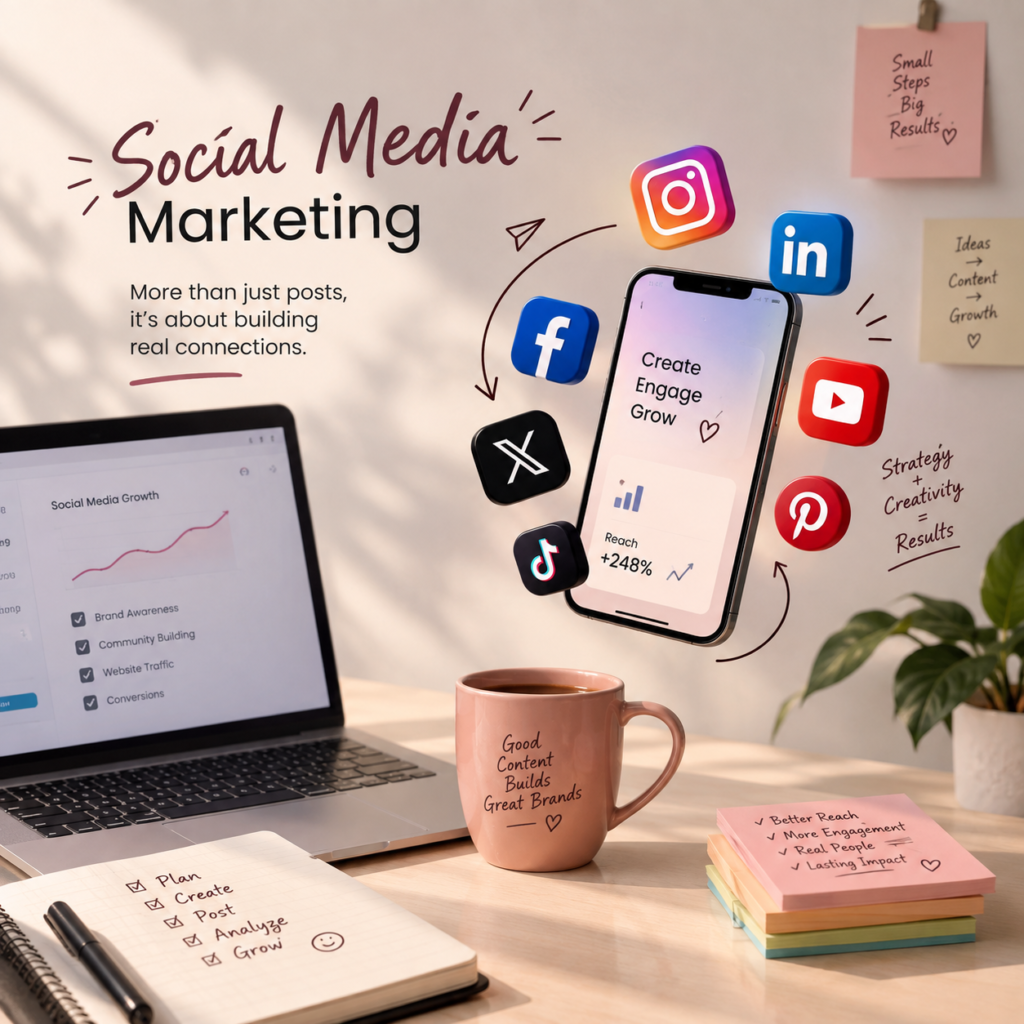
Businesses use platforms such as Instagram, Facebook, LinkedIn, YouTube, and TikTok to:
- Build brand awareness
- Reach potential customers
- Share valuable content
- Generate leads
- Drive website traffic
- Build customer relationships
- Increase sales
The important thing to remember is that social media marketing is not simply about posting every day.
The goal is to create content that gives people a reason to stop, engage, remember, and eventually take action.
Why Is Social Media Marketing Important for Businesses?
People spend a lot of time online, and social media has become a vital source of information for users engaging in online purchases.
Think of a scenario where you want to buy a new pair of shoes. You find a nice Reel on Instagram that catches your eye, and suddenly you are on the company’s page, reading reviews and watching other videos. You visit their site, and before you know it, you have purchased a pair of shoes.
This is an example of how social media can be used for business development, so companies must consider creating a presence there to aid the sales process.
Social media provides customers with a space to discover brands and receive product information.
Benefits of Social Media Marketing
1. Builds Brand Awareness
One of the main advantages of social media is reach.
A piece of useful or entertaining content can reach out to those who have not yet heard of your business. Consistent content keeps your brand in front of your target audience.
2. Helps You Connect With Customers
Social media gives businesses a direct communication channel with their audience.
Comments, direct messages, polls, Stories, and other interactive features allow businesses to understand what customers actually want.
3. Generates Website Traffic
You may also drive traffic to your website, blog, landing page or webstore through your social media posts, videos, stories and/or profile links.
4. Supports Lead Generation
Companies are now using social media to engage with their target customers and to generate leads. You can use social media to educate and inform your target market by giving valuable information such as educational content, offers, lead generation tools such as forms, messaging, and calls-to-action. This is helpful especially for product and service-based companies.
5. Supports Sales
Social media can also support your sales efforts by helping you to facilitate the buying process of your customers. This can be done by providing product demos, reviews, testimonials, how-to-educational content, and much more.
How to Create a Social Media Marketing Strategy
Posting randomly is one of the most common mistakes businesses make.
A proper social media marketing strategy starts with understanding what you want to achieve
Step 1: Define Your Goal
Begin your social media planning process by asking yourself one simple question:
“What do I want social media to do for my business?”
This can be anything from boosting brand awareness to generating sales leads. Define it as a SMART objective, for instance:
Increase brand awareness
- Increasing brand awareness
- Getting more leads
- Increasing sales
- Growing a community
- Driving website traffic
- Building authority
Step 2: Define Your Target Audience.
You don’t need to reach everyone.
You need to reach the right people.
Think about:
- Age
- Location
- Interests
- Problems
- Buying behavior
- Needs
- Preferred content formats
For example, a local restaurant and a B2B software company shouldn’t use exactly the same social media strategy
Step 3: Choose the Right Platforms
You do not need to be everywhere. Choose the social media outlets where your target audiences are.
Instagram is good for photos, Reels, products, creators, and lifestyles
LinkedIn works best for B2B, professionals, founders, and thought leadership
YouTube is excellent for video creation, long-form content, and community
Facebook has communities, small businesses, ads, a certain demographic. Depends on the company’s needs, customers, and product.
different social media marketing Platforms are better for different purposes.
Types of Social Media Content
A strong social media marketing strategy requires a strong mix of different types of content.
Educational Content
This type of content helps teach the audience something new.
- Tips
- Tutorials
- How to guides
- Industry specific news
- Common mistakes
- FAQs
Educational content is a great way to establish thought leadership and share your expertise with your audience.
Entertaining Content
Not every post has to be all about selling, selling, selling.
Memes, relatable posts, videos and other types of entertaining content are a great way to boost engagement and get your handle in front of more people.
Promotional Content
Your social media posts also need to promote what you actually offer.
- Product launches
- Discounts
- services
- special offers
- new features
are all great examples of promotional content.
Having a good mix of educational, entertaining and promotional content is important. If you post nothing but promotional content, your audience will get tired of you really quick.
Social Proof
People trust experiences from other customers.
Share:
- Testimonials
- Case studies
- Customer stories
- Before-and-after results
Social proof can reduce hesitation and help potential customers make decisions.
Social Media Marketing Trends in 2026
Social media is undergoing constant change, and one of the most significant changes is the growing use of artificial intelligence.
Artificial intelligence can help marketers come up with ideas, collect information, design variations, and even enable automation.
They don’t want more content, they want more value, more relevance, more authenticity and attention from the brand.
Short-form videos are a great way to not only explore new ideas but also discover brands.
A point to highlight is that while it’s good to go after trends, a steady content creation will organically grow your audience as opposed to chasing after something that might have a short lifespan.
This connects with a broader shift in digital marketing. If you’re interested in how technology is changing marketing. the future of digital marketing.
How AI Is Changing Social Media Marketing
AI is becoming part of many areas of digital marketing.
Marketers can use AI to:
- Generate content ideas
- Analyze audience behavior
- Create content drafts
- Repurpose existing content
- Analyze campaign performance
- Personalize messaging
- Automate repetitive tasks
But there is an important difference between using AI to create content and using AI to improve your marketing.
Simply generating hundreds of AI posts doesn’t automatically create a successful brand.
The strategy still needs human creativity, experience, storytelling, and audience understanding.
For a broader look at this transformation, check out AI in Business: How AI Is Changing the Future of Business.
Social Media SEO Is Becoming More Important
People don’t always use Google when they want to discover something.
They also search directly on platforms such as Instagram, YouTube, TikTok, and LinkedIn.
This means businesses should think about social media SEO.
Use relevant keywords in:
- Captions
- Video titles
- Profiles
- Descriptions
- Hashtags where appropriate
- On-screen text
Make it easy for both people and platform search systems to understand what your content is about.
This is part of a wider change in how people discover information online. My article on SEO vs GEO: Key Differences in 2026 explores another side of this changing search landscape.
How to Measure Social Media Marketing Success
Followers are not the only sign of success.
Although a page with 10,000 followers appears to be more successful than a page with 2,000 followers, it is not necessarily so.
The metrics that matter most to you should be your focus.
Some of the important metrics that may influence a company’s image are listed below:
- Reach
- Engagement rate
- Website clicks
- Leads
- Conversions
- Cost per lead
- Sales
- Return on ad spend
- Customer acquisition cost
So, if you are trying to get leads, a campaign with 100,000 views that does not result in any inquiries will be considered a failure.
Common Social Media Marketing Mistakes
Many companies make the same mistakes.
Post without strategy
Posting every day is not enough
Only the number of followers
While having followers is good, it is not the end-goal of a social media account
Copy your competitors
While they can give you some ideas, your competitors should not be the primary source of your content
Ignore comments and messages
Social media is a two-way street
Chase after every trend
Not all trends apply to your company
Be overly promotional
Give people value before asking them to buy.
Final Thoughts
Social media marketing in 2026 is about more than getting likes and followers.
It is about building a recognizable brand, building useful content, understanding your audience, and converting attention into business results.
The platforms will continue to change.
Algorithms will change.
New AI technologies will be introduced.
New content formats will become popular.
But one thing will stay important:
Understanding people.
Businesses that combine technology with creativity will be well-positioned to develop a strong digital presence. Strategy. Consistency. And providing customers with real value will be critical factors for success.
Don’t create content just to fill it up.
Create content that gives the audience a reason to remember your brand.