Google search is evolving rapidly as it provides AI-powered responses by amalgamating the information retrieved from multiple sources and not just blue links.
These responses are known as Google AI Overviews.
For businesses, bloggers, marketers, and website owners, a new query emerges “how to rank on Google AI Overviews?”
The good news is that there is nothing extraordinary about ranking on AI Overviews.
Google has emphasized that the basic principles of SEO remain operative for its AI models such as AI Overviews and AI Mode.
Your website should be able to be crawled, indexed, and have a good UX, along with being informative and trustworthy.
In this article, we will be discussing some of the most effective ways to improve your chances of being a featured in Google’s AI Overviews as a supporting reference.
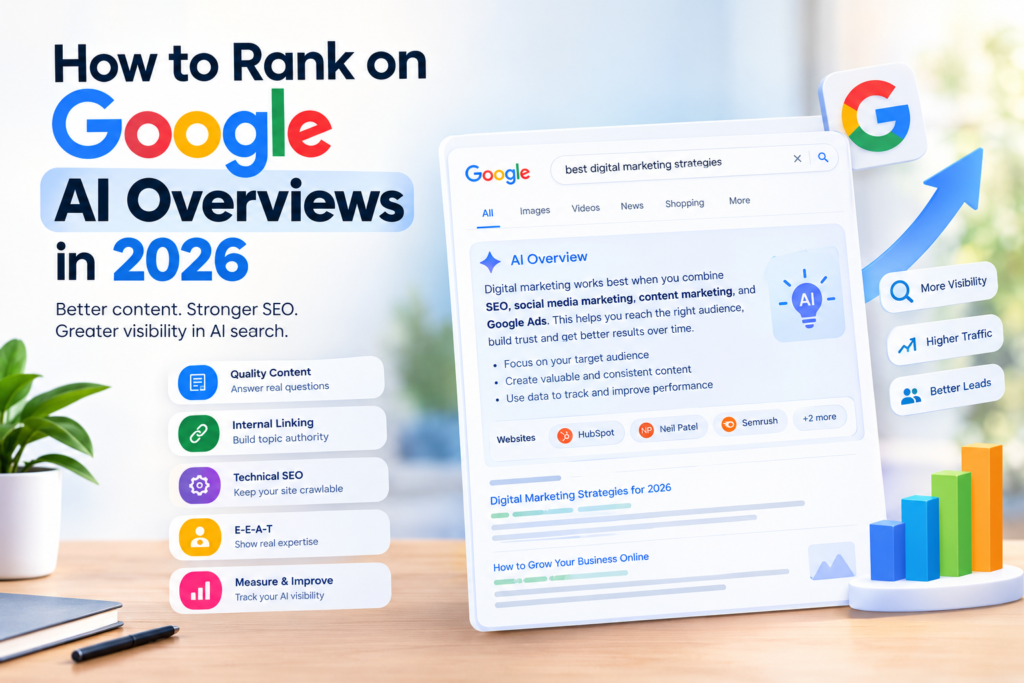
What Are Google AI Overviews?
Google AI Overviews are AI-generated summaries that appear in Google Search when Google’s systems believe that an AI-generated response would be helpful.
Instead of directing users to multiple sites to research a subject, an AI Overview provides a concise summary of the key points and links to websites where they can learn more if they want to investigate the subject further.
For instance, a user searching
“How long does SEO take to work?”
could see an AI-generated snippet that gives an overview of the common timelines related to SEO and links to websites where the user can find more information.
This changes things up.
Traditional approaches to SEO aim to optimize webpages for specific searches, but with AI-powered search engines, your content can serve as a source that contributes to Google’s ability to formulate an answer.
Can You Actually Rank in Google AI Overviews?
Yes, but there is an important distinction.
You don’t directly “submit” your website to an Google AI Overviews or use some special tag to guarantee inclusion.
Google notes that pages must meet standard technical requirements for Search and be eligible to appear with a search snippet, but there are no specific additional technical requirements for appearance in AI Overviews or AI Mode.
This means that your SEO fundamentals still matter.
Your website needs:
- Crawlable pages
- Indexable content
- Robust internal linking
- Helpful, unique information
- Good page experience
- Descriptive website structure
- Descriptive, relevant content
- Accurate structured data where appropriate
So rather than looking for an Google AI Overviews “hack”, think of ways to be a useful resource that Google can confidently reference
1. Create Content That Actually Answers Questions
The first lesson you need to learn in order to rank on Google AI Overviews is understanding search intent. You must recognize that people search for answers rather than keywords. Here are a few examples:
Keyword: Google Ads cost
Search intent: How much should I budget for Google Ads?
The worst article possible would be addressing the keyword “Google Ads cost” multiple times. In contrast, a good article would have addressed the following:
- Average budgeting approaches
- Factors which affect cost
- Cost per click
- Industry-specific differences
- Daily vs. monthly budget
- Conversion rates
- Measuring ROI
See, now the article provides a comprehensive answer, not simply stuffing keywords.
2. Build Topic Authority
A single article rarely allows for the establishment of a competitive entity around the topic at hand.
Build a constellation of related pieces around one of central importance, such as Google Ads, for example.
- Google Ads vs Meta Ads
- How much does Google Ads cost
- Google Ads Keyword Research Guide
- How to get more leads from Google Ads
- Google Ads for small businesses
- Common Google Ads mistakes
Link to each other to build a competitive silo of content that both searchers and search engines can easily navigate.
SEO, social media marketing, AI in business and digital marketing are other verticals that may similarly benefit from such an approach. If you want to see how the industry as a whole is set to evolve in the near future, be sure to check out the Future of Digital Marketing piece we have in store for you.
3. Use Clear Questions and Answers
AI search requires understanding the meaning of your content
Make your articles easy to scan
Use clear H2 and H3 headings like:
What are Google AI Overviews?
How do Google AI Overviews work?
How can I optimize my website for AI search?
Does SEO still matter for AI search?
And then provide direct answers under each heading
This does not mean writing content only for AI
You’re also making the article easier to read by humans
A good rule is:
Write for people, but structure it so it’s easy for search engines to understand
4. Add Original Insights
This is one of the best opportunities for small sites.
There is already much on the web about generic topics.
If someone writes something the same as the next guy, why should people or search engines go to their site?
Make the article a bit different by adding
- Your own marketing experience
- Campaign observations
- Examples from real businesses
- Screenshots
- Original data
- Case studies
- Personal opinions backed by reasoning
- Practical checklists
- Step-by-step processes
Instead of just saying SEO is important for businesses, give what you have seen working with it or what is commonly done wrong. What you have done makes the article more valuable.
For example, instead of writing:
“SEO is important for businesses.”
Explain what you’ve observed when working on SEO projects and what businesses commonly get wrong.
Your experience becomes part of the content’s value.
5. Make Your Content Easy to Crawl
Before you start to think about how to leverage AI search, double-check Google’s ability to access and index your site.
- Not blocked unnecessarily by robots.txt
- Properly linked internally
- Accessible to Googlebot
- Indexable
- Using descriptive titles
- Using clear headings
- Providing important information in text
Your website’s architecture is crucial to Google, since Google’s AI search relies on information that is available inside of Google’s Search index.
If the content cannot be indexed or crawled properly, it becomes much harder to show up in the AI search results.
6. Strengthen Internal Linking
Internal linking is one of the easiest SEO improvements you can make.
Suppose you were to write an article about Google AI Overviews.
You could naturally link to related articles about:
The Future of Digital Marketing
SEO vs GEO
AI in Business
For instance, if you are investigating how traditional search is evolving, you should read our SEO vs GEO: Key Differences in 2026 guide to understand the difference between traditional search optimization and Generative Engine Optimization.
You can also learn more about how artificial intelligence is transforming companies in our AI in Business guide.
Do not add links randomly.
Ask yourself:
“Would this link help the reader understand this topic better?”
If the answer is yes, add it.
7. Don’t Forget Traditional SEO
AI search does not mean the end of SEO.
In fact, Google has emphasized multiple times that SEO best practices still apply to generative AI features within Search.
That means you should continue to invest in
- search intent
- keyword research
- helpful content
- technical SEO
- internal linking
- mobile-friendly design
- page experience
- website structure
- relevant backlinks
- clear metadata
Think of AI search as an evolution of search — and a compliment to your overall SEO strategy. SEO tactics will always be relevant as they are the foundation of search.
8. Optimize for Long-Tail Searches
AI search makes conversational queries increasingly important.
People may search:
“What is the best digital marketing strategy for a small business in Kerala?”
instead of:
“digital marketing Kerala.”
Create content that addresses specific problems and detailed questions.
Long-tail topics can also help you demonstrate expertise because you can provide a more complete answer.
Instead of publishing one generic article called:
“Digital Marketing Guide”
you could create focused content such as:
“Digital Marketing Strategies for Small Businesses in Kerala”
The more clearly you understand your audience, the easier it becomes to create useful content.
9. Use Structured Data Correctly
Structured data helps Google to understand your page and its contents.
But don’t think of using schema markup as an alternative for appearing in google AI Overviews.
Google’s guidelines state that there is no specific schema.org markup required to appear in AI Overviews or AI Mode.
Use structured data on your pages where it makes sense and be sure that the structured data reflects the contents of the page.
Focus on providing valuable content and a technically sound website.
10. Measure Your AI Search Visibility
SEO without measurement is incomplete.
Google has announced dedicated reporting for generative AI visibility within Search Console,
thereby providing more information about the performance of content featured in the generative AI responses.
This means that website owners can increasingly focus on what matters to them, beyond their traditional SEO considerations.
Monitor:
- Organic clicks
- Impressions
- Search queries
- Top-performing pages
- Conversions
- Engagement
- Generative AI visibility when it’s available
Avoid focusing on whether you appear in one answer box. Rather, look at whether your general visibility and business outcomes are increasing.
11. Avoid “AI SEO Hacks”
As AI-enabled search has evolved, an increasing number of purported optimization techniques have surfaced on the web.
Avoiding the temptation to create unnecessary AI-specific files, keyword-stuffed every paragraph and published hundreds of low-quality pages simply because you think Google or other search engines will be fooled is a much better idea.
Google’s latest guidelines stress the importance of informative, unique, people-centric content and caution against creating vast amounts of low-quality content designed to manipulate search results or generative AI systems.
The simplest solution is always one of the best:
SEO Is Still the Foundation of AI Search
So, how do you rank on Google AI Overviews in 2026?
Well, there is no secret button.
The most optimal way to benefit from Google AI Overviews is to make sure that your website is worthy of being found by people in the first place.
- Create unique content
- answer real questions
- research search intent
- build topical authority
- increase internal linking
- maintain technical SEO
- use schema
- track your performance
- deliver more value than anywhere else online
Google’s AI search experience may change in the coming years, but the ultimate goal of providing useful information will likely remain the same.
By focusing on creating a website that is helpful to your audience, you’ll not only be positioning yourself to appear in Google AI Overviews, but you’ll also be doing SEO the right way and setting yourself up for success in the ever-evolving world of digital marketing.
Final Thoughts
Google AI Overviews are changing the information landscape, but they will not eliminate the need for SEO.
SEO will become even more important!
The companies that are successful will not be the ones that are pushing out the most content. They will be the ones creating the most useful, trusted, original and well-structured information about your niche.
Start with optimizing the best content on your site,
then build related content around it, and
use internal linking to connect it all together. The key is to test and see what works.
SEO is changing. You need to change with it.